I am currently working on a unit with my eleventh-grade students that is part novel study and part creative writing. For context, I just started teaching this class this semester to replace a teacher who went on a leave of absence. The students have spent the better part of the last few months preparing for the New York State English Regents exam. This exam is the culminating test for the high school English course. All eleventh grade students must take the exam, and a passing grade is necessary for students to be able to graduate high school.
If you’ve ever had the joy of taking over a class in the middle of the school year, then you understand the complexity of it being “September” for you but also the middle of the school year for the students, which means I have to simultaneously get to know who they are and what they can do, while also continuing that learning and curriculum they started in the beginning of the school year. This experience pushed me to think more intentionally about how mentor texts and teacher-as-writer practices can open space for student voice.
One of the core novels in our eleventh-grade curriculum is The Great Gatsby, which the previous teacher had not yet taught. This is a novel I have not taught before, and is one of those canonical texts that is not necessarily my favorite. As I struggled with how to begin, and also do my own homework of rereading a text I last read over five years ago, I kept feeling like I wanted to do something else. You see, as a teacher I like to start with a novel that I am passionate about or a crowd pleaser to engage the students. I’ve always felt that excitement will translate. Therefore, starting with something engaging will help me connect with the students, and ultimately bring them along when the challenges or texts get more demanding.
In addition, most of the eleventh-grade teachers tend to do something “lighter” with the students after the English Regents exam to balance the weeks of test preparation and assessment writing. This led me to my revelation – and to the text The Poet X by Elizabeth Acevedo.
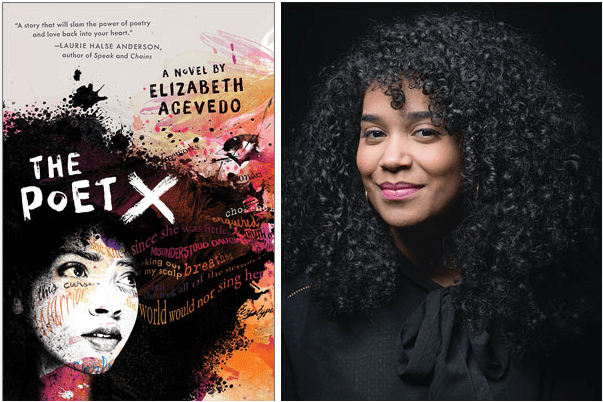
I selected the text for two reasons. The first is that a novel in verse about a high school girl who resembled the students in my class would move quickly and feel like a break from the work they’d done in class for the last few weeks. Secondly, the main character, Xiomara, writes about her own life and experiences in a way that would easily generate writing prompts and also might help inspire my own students’ writing.
To kick off this unit I gave the students writing journals, and spent the first few days generating lists that students could use as inspiration, and then use those lists to write about their own lives. I also shared some videos of the author, Acevedo, sharing her spoken word poetry, not only to engage them in the novel but also hear the piece of writing with the power, intent and inflection created by the author.
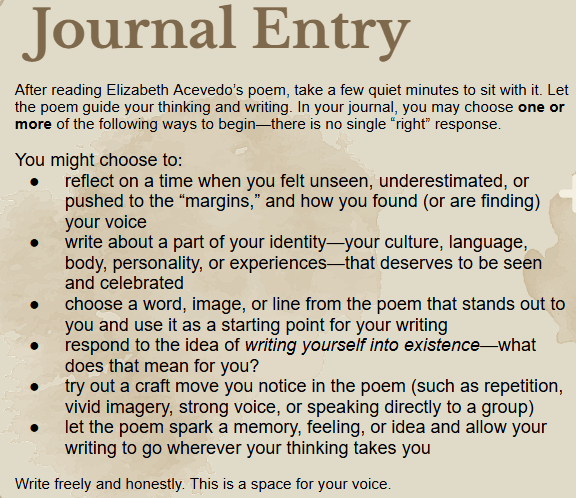
One of the shared videos shared in class included this video from 2018 of Acevedo sharing “This is For Us” after The Poet X, her debut novel, was published. I also gave the students a copy of the poem and asked them to analyze the craft moves made by the author. Finally I asked the students to select one of the following invitations to write in their journal notebooks in response to the poem.
Based on research from some of my favorite literacy pedagogues including Penny Kittle, Kelly Gallagher, Ralph Fletcher, and Nancie Atwell, I also understand the importance of modeling writing with your students to not only inspire them, but also help them see the struggles all writers face as they embrace the blank page. After listening to and reading the poem I was inspired by the following line:
Not worthy of being the hero or the author
This resulted in the following piece of writing, which I shared with my students and then asked them to share either the inspiration line or a golden line from their own writing with the class.
Sometimes it feels like there’s no space to be the author.

And the hero is even too much to hope for.
Heroes have pressure
have weight
have responsibility that can often be too much to bear

But authors can begin. 	Can create. 		Can make something new.
Make something grow out of nothing.
Authors can speak new things into existence
or echo the feelings and experience of others.
Even when there is silence, authors speak into the void.
Gathering the troops.
Rallying a cry.
Building community.
Saying 				YOU BELONG HERE
You are welcome.

Maybe we are all more worthy of being an author.
Someone to open the space, or make a new one.
A space where you can be the best version of you.
A space where you can close off the haters and the nay-sayers.
A space where you allow the strongest part of you to shine.

Where you close off the negative voices.
The people telling you what you can’t
what’s not

Focus on the YES!
The positive
The can do
And be that person

Live that life
Have that experience

Because we only get one chance at this thing called life.
So why not make it the best place you can be?
Why dwell on what’s not going to happen?

When there is plenty of possibility.
As I take a look at the writing the students have created so far, I see kernels of inspiration that could turn into impactful writing or be used in their college essay. I look forward to seeing where this journey takes us, as well as the connections I will make with the students.
Moments like these remind me that when we write alongside students and place powerful mentor texts at the center, we create conditions for possibility. Teaching is messy. Therefore I do not pretend that I have this all figured out. However, if we don’t take the leap and try, then we lose out on the possibility of greatness within ourselves and our students.
If you’re experimenting with writing alongside your students, I’d love to hear what you’re trying. Happy writing!
 Teaching with Equity